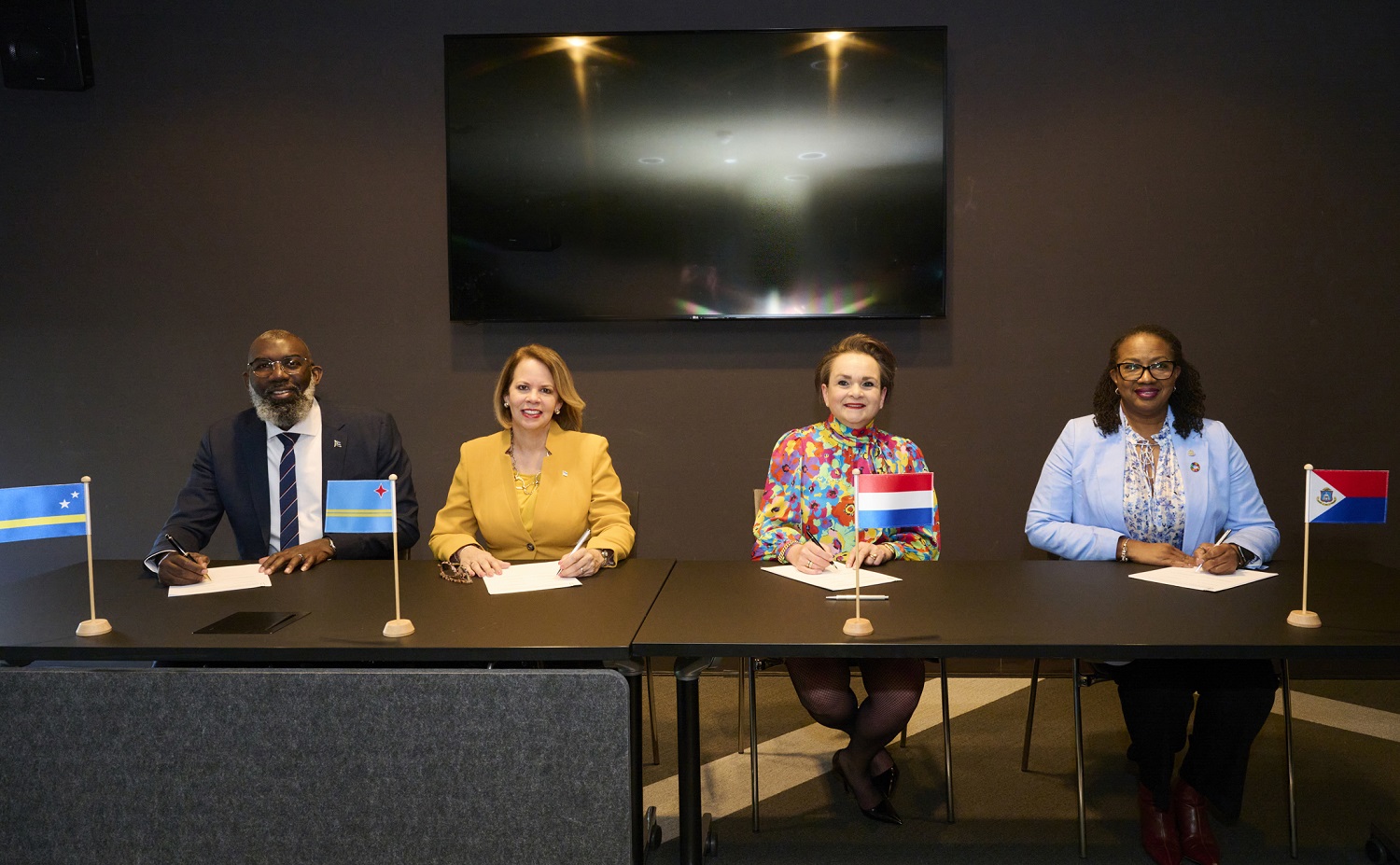
Mutual agreement on partnership for reform
Since late 2020, Aruba, Curaçao and Sint Maarten (hereinafter: the Countries) have been working with the Netherlands to reform their public sectors as agreed in the Country Packages. This partnership aims to strengthen the economies of the Countries to improve the welfare of their inhabitants. This partnership has been based on three temporary bilateral agreements until now, in anticipation of the establishment of a formal legal framework. On the 4th of April of this year, the prime ministers of the Countries and I signed a mutual agreement establishing this legal framework. The purpose of this letter is to share this common agreement – including various annexes – with your Chamber, along with a more detailed explanation of the content of the agreement and its origins. I have also included the first Implementation Report for 2023 with this letter. It includes a description of the progress made so far and the Implementation Agendas with agreements for the second quarter of 2023.
Background
As we are all aware, the corona pandemic had serious financial, economic and social consequences for the Countries. It became clear that their economic resilience and administrative capability needed to be improved. To this end, reform packages were agreed with each of the Countries in late 2020. These are known as the Country Packages. It was also agreed that the Netherlands would provide support for and monitor the implementation of these reforms through the Caribbean Body for Reform and Development (Caribisch Orgaan voor Hervorming en Ontwikkeling, COHO) and that this procedure would be formalised in a consensusrijkswet (an act of parliament voluntarily adopted by all countries of the Kingdom of the Netherlands). Following extensive discussions about the exact contents of this act, a bill was submitted to your House and the Estates of the Constituent Countries on the 9th of February 2021 on behalf of the four constituent countries of the Netherlands.
The report that your Chamber submitted in response to the bill was critical. While support can be found for the underlying objective of the bill, various parties submitted critical responses. The same applies to the reports from the Parliament of the Countries. As I have already explained, these reports led the prime ministers and I to conclude that there is limited support for the bill, particularly in the Countries, and that the required consensus for the bill is therefore lacking. We thus decided to critically re-examine the bill and explore potential alternatives. The objective of the bill, i.e. the implementation of reforms to increase the economic resilience of the Countries, remained the priority. During our discussions, the prime ministers and I noted that all four of us are satisfied with the way we have worked together to achieve that objective since late 2020. We therefore agreed to continue this way of working, in which the Netherlands supports the reforms through a working organisation that falls directly under my ministry. This means that a separate COHO administrative body will not be established. This eliminates the need to pass a consensusrijkswet (see above), as this legal instrument was primarily chosen to facilitate the proposed establishment of this independent administrative body. It was instead decided to codify the agreements in a flexible common agreement based on article 38, first paragraph, of the Charter for the Kingdom of the Netherlands.


After the Countries produced an initial proposal for the contents of this agreement in September 2022, we reached an outline agreement on several important amendments to this draft version in January. The four countries subsequently spent the past few weeks working intensively on the common agreement – including the accompanying notes and three bilateral procedural agreements – that was signed by myself and the three prime ministers today. The result is an agreement that has come about through mutual agreement and is based on equality. It can thus count on the support of all four governments. This is a great result, and I wish to thank the Countries for their constructive approach to the process.
Now that the mutual agreement has been signed, I have initiated the process of withdrawing the COHO bill. Your Chamber will be informed about this as soon as possible.
Content of the agreement
By signing this mutual agreement, the governments of Aruba, Curaçao and Sint Maarten have made a long-term commitment to implement the reforms to their public sectors, with the objective of increasing their economic resilience and administrative capability. The Netherlands has committed to supporting this process by making people and resources available. By implementing this agreement, we will continue the partnership that has taken shape during the past two years. The preamble of the agreement establishes three leading principles for the partnership, namely ownership, equality and communality. The Netherlands and the other three countries are highly committed to these principles, which also reflect the way of working that has arisen during the past few years. Ownership by the Countries is crucial to ensure that the reforms are actually implemented and that the results stand the test of time. The principles of equality and communality express the relationships between the parts of the Kingdom and also promote the aforementioned ownership.
The partnership continues to be based on the Country Packages agreed with each Country in late 2020. Article 3 of the agreement allows for the possibility of amending the content of these packages if the Netherlands and the Country in question agree on the amendment and once the Estates of the Country have been informed. The Temporary Working Organisation (TWO) within my ministry will continue to exist to support the implementation of the Country Packages. The TWO works in partnership with the Implementation Organisations that have been appointed in each of the Countries under the prime ministers. They are collectively tasked with supporting, guiding and monitoring the implementation of the reforms (article 4). The TWO has an annual budget of more than €30 million until 2027 for this. Around €6.5 million of this budget will be spent on the overhead costs associated with the TWO’s own employees and hiring experts from other departments. The remaining budget may be used to finance reform projects or to make additional expertise or implementation capacity available (article 9).
The agreed way of working reflects the way we have worked together on the reforms during the past two years. This means that your House, as well as the Senate and the Parliaments of the Countries, will continue to receive implementation agendas and implementation reports twice annually. The implementation agendas include the reform projects, programmes and measures that will be prepared or implemented in the coming period, including the results to be realised and the associated time spans (article 5). These projects, programmes or measures can subsequently be developed into action plans (article 6). The implementation reports contain a summary of the progress made towards implementing the planned activities (article 7). To express the ownership by the Countries, the implementation reports – as has already been the case for the implementation agendas during the past two years – will be jointly prepared by the TWO and the implementation organisations. The exact procedures are specified in greater detail in three bilateral procedural regulations. These are included as annexes to the common agreement.


As the implementation agendas and reports will now be produced jointly, and because the action plans require the agreement of the Netherlands, agreement must be reached about the content of these. It is conceivable that this may not always be possible in every respect. Article 8 of the common agreement specifies that an independent mediator will be appointed in such cases. The objective of the mediation process is to reach agreement about the point of contention. The mediator will submit a proposal to this end.
The mutual agreement is effective from today and is intended to remain in effect for four years, i.e. until the 3rd of April 2027. The agreement may be extended for periods not exceeding two years after that date (article 11). An evaluation is planned after three years (article 10).
As specified in article 8, first paragraph, an independent mediator will also be appointed if agreement cannot be reached about the appointment of the chairperson of the evaluation committee (article 10, second paragraph, under a) or about agreements for the realisation of projects that are not completed before the expiry of the agreement that are financially supported by the Netherlands (article 11, fifth paragraph).
Legal protection protocol
The mutual agreement specifies that the General Administrative Law Act (Algemene wet bestuursrecht) applies (with the necessary modifications) to the allocation of funding for reform projects and measures by the Netherlands (article 9 paragraph 3). This decision formalises the existing practice for the public funding of projects in the Countries by the Netherlands in recent years. A consequence of this decision is that Caribbean administrative bodies with a potential interest in a funding decision have recourse to the Dutch administrative courts if a dispute arises about such decisions. Given the unusual legal relationship that exists, it is not possible to determine beforehand with complete confidence whether the administrative courts will decide they are competent to handle such disputes. There are no legal precedents for this situation. The governments have agreed a protocol to ensure that specific disputes do not lead to an interruption to the legal protection. In this protocol, the governments have agreed that, in such situations, they will amend the mutual agreement in such a way that the Caribbean countries are still able to benefit from legal protection. This protocol is included as an annex to this letter.
Implementation progress
The first implementation report for 2023 and the implementation agendas with agreements for the 2nd quarter of 2023 are also included with this letter. These are the final agendas and report that were produced under the old system, i.e. before the mutual agreement became effective. As explained above, the system of implementation agendas and implementation reports will be continued during the coming four years, although the implementation reports will be produced jointly in future – as will the implementation agendas.
As evidenced by successive implementation reports, great results have already been achieved and important steps taken during the past two years towards implementing the Country Packages. For example, I appreciate the decisive approach taken by the minister for Social Development, Work and Welfare (Sociale Ontwikkeling, Arbeid en Welzijn, SOAW) in Curaçao towards implementing the necessary reforms to the labour market and social security system. The same applies to the way that Aruba has initiated a dialogue with the trade unions and employers about modernising the labour market. Sint Maarten has taken a decisive and positive approach to facilitating implementation of the General Health Insurance system from the 1st of January 2024.
However, we must also realise that many reforms are only just starting. This is understandable to a certain extent, given the scale and complexity of the challenge and the resulting importance of careful preparation. At the same time, I observe several areas that require attention in the implementation of the reforms that touch on the guiding principles of the mutual agreement, namely ownership, equality and communality. These principles are crucial to a successful partnership. I pointed out earlier in this letter than the reforms will not succeed if the governments of the Countries do not assume ownership of the process. For me, ownership is not just about having autonomy, but also about truly taking responsibility as a government for the future of your country and its inhabitants, even when that requires difficult decisions. When I look back on the implementation of the Country Packages during the past two years, I unfortunately see that these difficult decisions have sometimes been avoided or postponed. I also see that the principle of communality has sometimes been threatened by a failure to share all relevant information about the reforms. In this regard, I am specifically concerned by the reticence displayed by Curaçao. This has become increasingly apparent in the implementation reports of the past year. The partnership here has become strained in multiple areas, for example in relation to the reform of the online gambling sector. Less and less information is being shared about this process.
I have spoken to the prime ministers about the challenges I see. It is important that we continue to collectively respect the principles of our partnership: working together decisively to increase the economic resilience and administrative capability of the Countries. I commit wholeheartedly to that goal, and I expect the t Countries to do the same.