
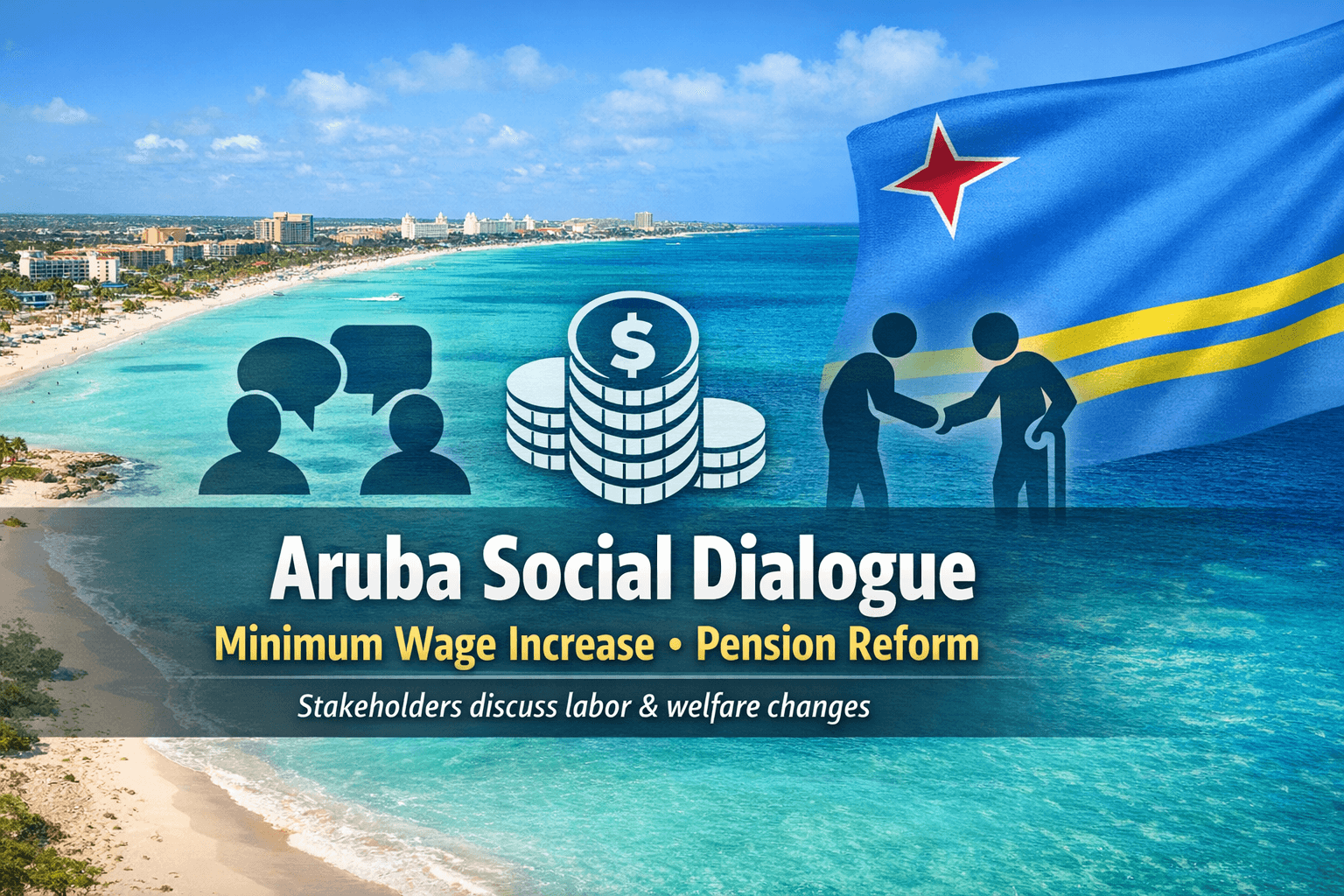
Aruba Social Dialogue on Minimum Wage Increase and Pension Reform: What Businesses Must Know
The Aruba Government has invited key stakeholders to a new Social Dialogue focusing on the Aruba minimum wage increase and major legislative reforms. These proposals could significantly reshape the cost of doing business on the island. As discussions unfold, employers, unions, and insurers must prepare for potential economic shifts that may affect payroll structures, pension obligations, and social contributions.
Government Invites Stakeholders to Social Dialogue
AHATA recently received an official invitation from the Prime Minister’s office to participate in Social Dialogue meetings. The sessions are scheduled to address urgent labor and economic matters.
Although attendance was declined due to prior commitments and short notice, the discussions remain highly relevant to Aruba’s business community.


The invitation was extended to:
- Employers’ organizations
- Labor unions
- Insurance companies
- Key economic stakeholders
Interestingly, this is the same group that met last August to discuss updates to Aruba’s pension legislation, specifically the LAP reform.
These repeated consultations show that the Aruba minimum wage increase and pension reform remain central to government policy planning.
Aruba Minimum Wage Increase Toward a Living Wage
One of the most critical agenda points is the phased increase of the minimum wage toward a living wage level over three years.
The proposal aligns with the advice of the Social-Economic Council (SER), outlined in its January 2026 report titled:


“Adjustment of the Minimum Wage in Three Phases Toward the Subsistence Minimum.”
The SER emphasizes that Aruba’s statutory minimum wage should gradually approach the subsistence minimum. According to its analysis, the income gap between the current minimum wage and the cost of living remains significant.
Moreover, the Council notes that a structured and phased approach reduces economic shock. Therefore, the Aruba minimum wage increase would likely occur in three stages.
However, while employees may benefit from higher earnings, employers face rising labor costs. Consequently, businesses must assess operational budgets carefully.
Economic Impact of the Aruba Minimum Wage Increase
The SER report highlights several financial implications:
- Rising payroll expenses
- Potential spill-over wage adjustments
- Higher operational costs for service sectors
- Possible inflationary pressure
According to the advisory, the wage gap currently stands at approximately 25%. Closing this gap immediately could create instability. Therefore, a gradual adjustment is recommended.
Additionally, employers may experience “spill-over effects.” When minimum wages increase, other salary brackets often rise proportionally. As a result, total wage bills may expand beyond the lowest-paid employees.
For further reading on Aruba’s labor market developments, see our related coverage on Aruba economic outlook and wage reforms.


Internationally, institutions such as the International Labour Organization (ILO) recognize living wages as essential for social stability. However, implementation must balance economic sustainability.
Pension Reform and LAP Update
Another major agenda item concerns updates to the pension law (LAP). Previously discussed proposals require employers to:
- Offer private pension insurance
- Match 3% of employee salary in premium contributions
Government and unions are now seeking to increase retiree benefits further.
While improving retirement security is commendable, mandatory employer contributions directly raise employment costs. Therefore, small and medium enterprises may face new financial pressure.
Long-Term Business Implications of Pension Reform
Mandatory pension contributions increase fixed labor costs. Over time, this can:
- Reduce hiring flexibility
- Limit investment capacity
- Increase service pricing
Although pension reform strengthens worker security, policymakers must consider Aruba’s economic competitiveness.
Balanced reform ensures sustainability for both employees and employers.
Proposed Living Wage Policy and SER Recommendations
The SER report strongly supports linking minimum wage to a structured reference model. However, it warns against sudden adjustments.
Specifically, the Council recommends:
- Phased implementation
- Clear evaluation moments
- Economic impact assessments
- Ongoing consultation with social partners
The advisory stresses that economic data must guide every phase. Moreover, government decisions should align with productivity levels and sectoral capacity.
For global economic guidance, refer to the International Monetary Fund (IMF), which frequently evaluates labor market reforms in small economies.
Mandatory Paid Charity Leave Proposal
Another proposal under discussion would legally require employers to grant employees two paid days annually for charity work.
While socially beneficial, this measure effectively increases paid leave costs. Consequently, productivity and scheduling flexibility may decline, especially in service-driven industries such as hospitality.
Although corporate social responsibility strengthens community bonds, businesses must weigh operational realities.
Proposed Senior Care Law and Potential Premiums
The government also plans to introduce legislation regarding long-term senior care.
Although details remain limited, such policies often involve:
- Additional social premiums
- Employer-based contributions
- Tax adjustments
Therefore, this measure could add new financial obligations to payroll structures.
Carefully structured funding mechanisms will be essential to prevent excessive burdens on employers.
Financial Support Law for Children with Impairments
Another proposed law aims to provide financial support for children with impairments.
This initiative promotes inclusivity and social protection. However, if funded through payroll-related contributions, employers may absorb additional costs.
Balancing social welfare expansion with economic competitiveness remains crucial.
Government Financial Surplus Context
Notably, Aruba’s Government, AZV, SVB, and several state-owned entities are reportedly experiencing strong financial surpluses.
Dividends from public entities further contribute to government revenue.
Therefore, stakeholders may question whether new employer obligations are necessary given current fiscal conditions.
Transparent financial analysis will strengthen public trust in the Social Dialogue process.
Future Topics for Social Dialogue
The final agenda item includes identifying new themes for future discussions.
Given Aruba’s evolving economy, potential topics may include:
- Workforce productivity
- Inflation management
- Tax reform
- Digital transformation
- Tourism labor sustainability
Constructive dialogue between government, employers, and unions remains essential.
Why the Aruba Minimum Wage Increase Matters Now
The Aruba minimum wage increase debate arrives at a pivotal economic moment.
On one hand, workers face rising living costs. On the other hand, employers manage operational pressures in a competitive tourism market.
Therefore, gradual reform supported by data appears most sustainable.
The SER clearly advises structured implementation with built-in review points.
Moreover, consistent communication between stakeholders ensures balanced outcomes.
Conclusion: Balancing Social Progress and Economic Stability
The upcoming Social Dialogue meetings represent a critical moment for Aruba’s economic future.
The Aruba minimum wage increase, pension reform, and additional legislative proposals collectively affect the cost of doing business.
Although social progress strengthens communities, sustainable implementation safeguards economic growth.
As discussions continue, businesses must remain informed, proactive, and engaged.
A balanced strategy can support workers while preserving Aruba’s competitive advantage.
For more local news, visit us and follow our social media pages. Share your news with us by sending it to info@arubaonline.news.