
Number of employed in the Caribbean Netherlands continued to rise in 2022
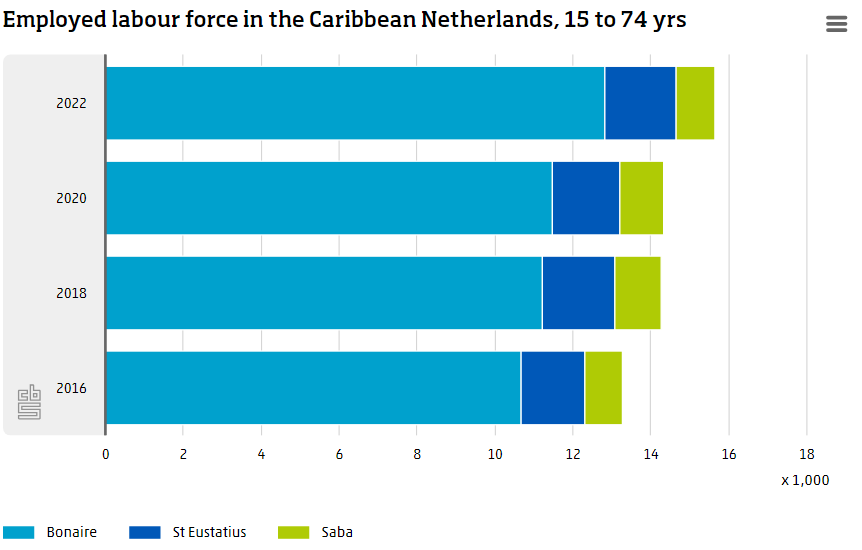
In 2022, the employed labour force aged 15 to 74 years in the Caribbean Netherlands increased by 9 percent to 15.7 thousand relative to 2020. During the coronavirus pandemic in 2020, the number of employed stagnated. Of the three islands, Bonaire saw the highest growth. There were more employed people both among the local island population and among immigrants. This is evident from the most recent Labour Force Survey Caribbean Netherlands, conducted by Statistics Netherlands (CBS).
On Bonaire, the employed labour force grew by 1.4 thousand (+12 percent) to 12.8 thousand in 2022 relative to two years previously. Of all 15 to 74-year-old residents, 72.5 percent were in employment. In 2020, the net labour participation rate was still 69.8 percent.
On St Eustatius, the employed labour force rose by 5 percent to 1.8 thousand. The proportion of people in work amounted to 72.9 percent.


Only Saba saw a decline in the number of employed; around one thousand people were in employment on this island in 2022, 120 fewer than two years previously. On Saba, 67.0 percent of the population aged 15 to 74 years were in work.
More immigrants and more locals in employment
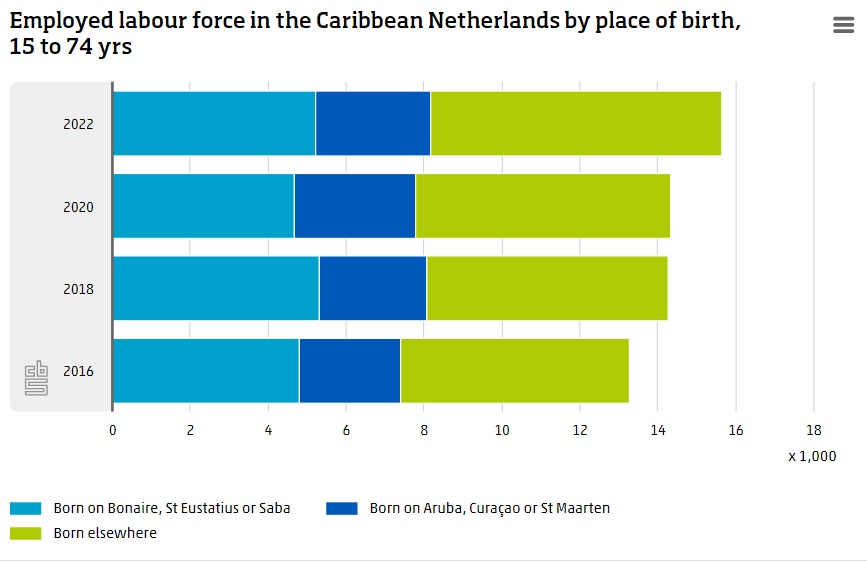
The number of local people in employment rose by 410 to 8.2 thousand and is back at the level of 2018. Local people in employment are employed people who were born on one of the islands of the former Netherlands Antilles, i.e. the islands of the Caribbean Netherlands or Aruba, Curaçao or St Maarten.
In 2020, during the coronavirus pandemic, particularly the number of local people in work declined, by 320 to 7.8 thousand. The number of employed people born elsewhere did grow in 2020 and then continued to increase by 940 to 7.5 thousand.
Relatively sharp increase in employed Dominicans and Colombians on Bonaire
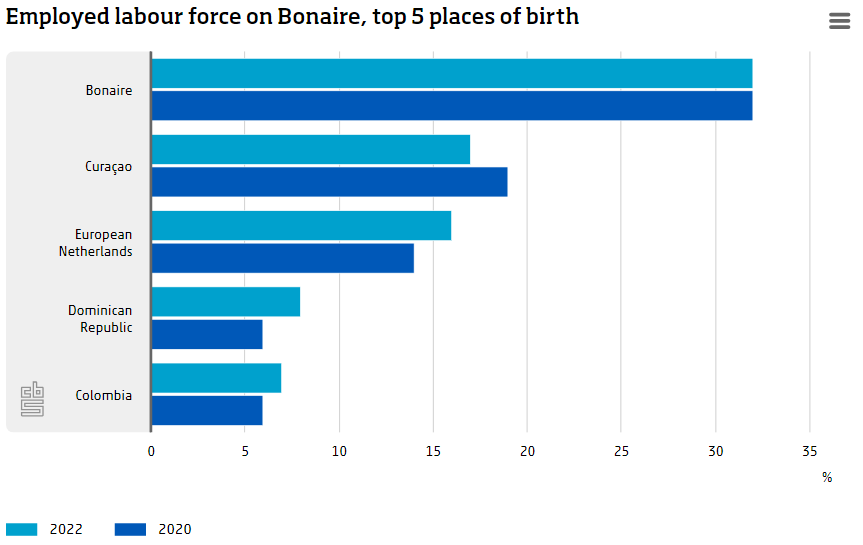
In 2022, almost a third of those working on Bonaire were native-born Bonaireans. In absolute terms, this group saw the largest growth (+500). The number of employed from other countries increased as well, leaving the percentage of Bonaireans in work unchanged. Bonaireans mainly work in public administration, education and construction. In second place were employed people from Curaçao, with a percentage of 17 percent born here.


Among immigrants, in particular the increase in Dominican and Colombian nationals working on Bonaire is relatively large. Compared to 2020, the number of employed from these countries rose by more than 40 percent each last year. They were mainly working in construction and in accommodation and food services.
Also more employed people from the Dominican Republic on St Eustatius
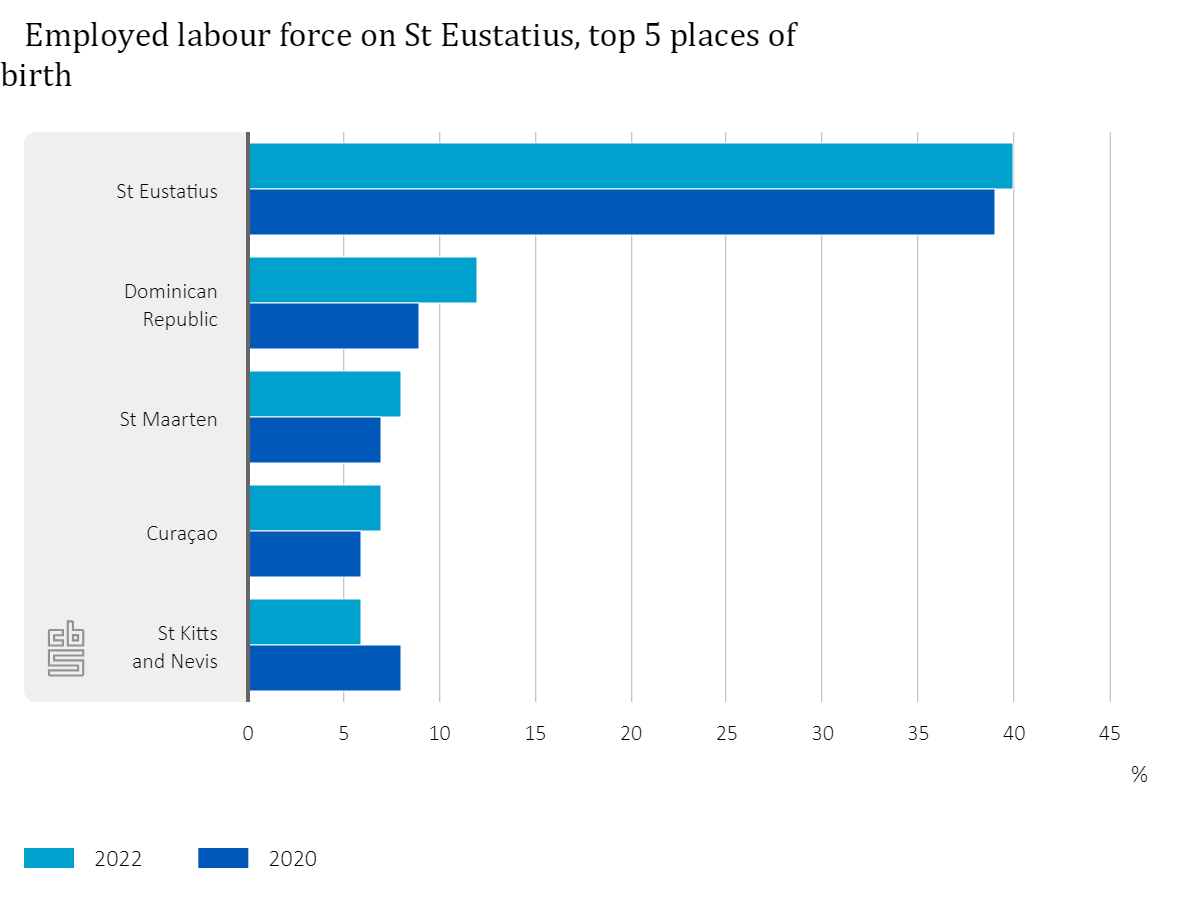
Over 40 percent of the people in work on St Eustatius were native-born Statians last year. Especially in education, the number of native Statian residents in employment has increased over the past two years, doubling relative to 2020.
In second place is the employed labour force born in the Dominican Republic (12 percent). Relative to 2020, the number of employed in this group grew by 36 percent. They mainly worked in accommodation and food services.
Fewer non-locals in work on Saba
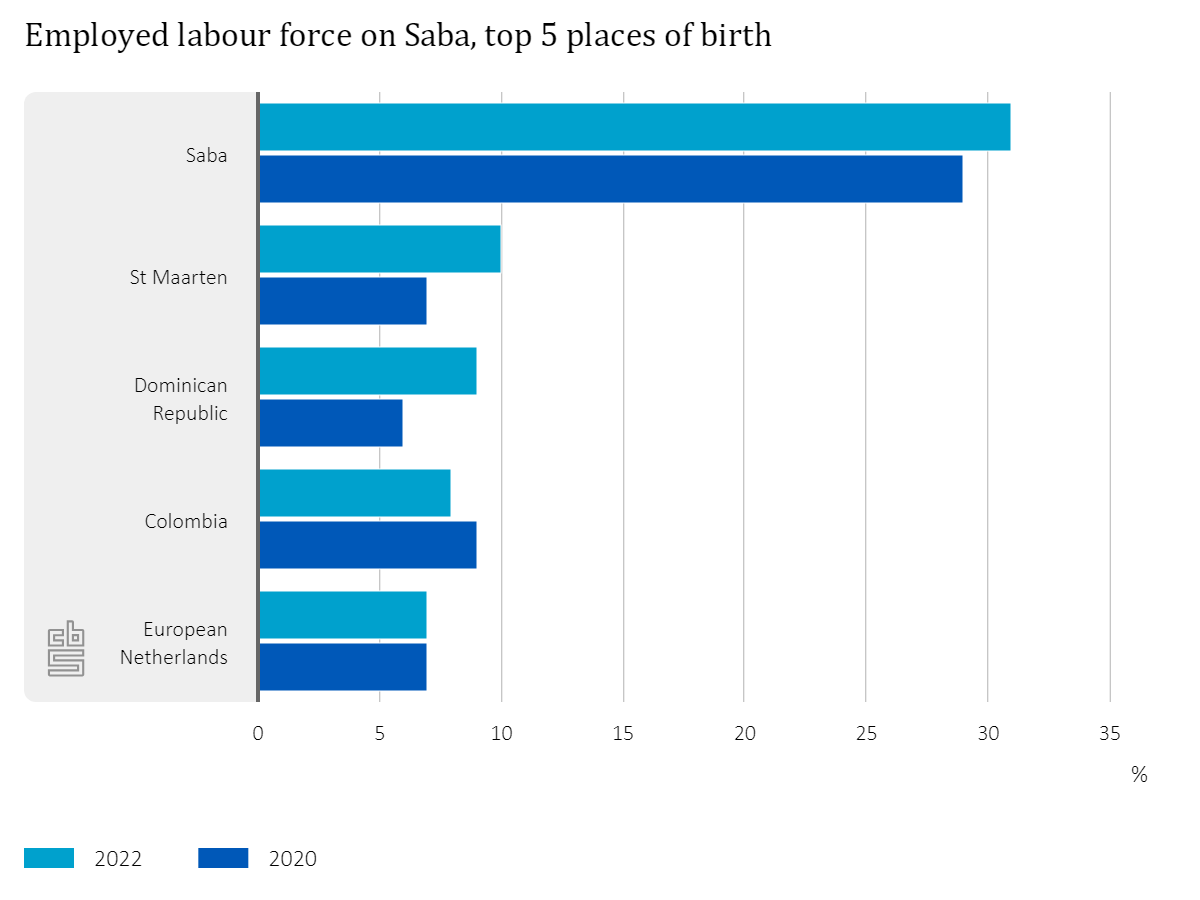
Around 31 percent of the employed labour force on Saba were native-born Sabans in 2022. They formed the largest group of all employed people on Saba, mainly working in public administration. Employed people who were born on St Maarten rank second (10 percent). The lower number of employed on Saba is particularly seen among non-native island residents.


Explanation:
Coronavirus pandemic
In 2020, the coronavirus pandemic broke out. The measures that came into effect in mid-March 2020 to combat the spread of coronavirus included closing the airspace of the islands and putting a halt to cruise traffic. As a result, foreign tourism on the islands came to a complete standstill. Island residents were still allowed to move freely on the islands. When the LFS-CN 2020 was carried out, it was possible to travel to the islands by plane again, but not yet by cruise ship. The Dutch government made financial support packages available for workers and companies on the islands that were affected by the restrictive measures. When the LFS-CN 2022 was conducted, the coronavirus pandemic and associated measures had ended. Developments in the figures cannot be unambiguously attributed to the coronavirus crisis.
Number of employed born elsewhere
Employers in the Caribbean Netherlands must make a number of mandatory efforts to always fill vacancies with local staff first. Only if this fails will employers be allowed to hire people from outside the islands. For Dutch nationals coming from Aruba, Curaçao or St Maarten, for European Dutch nationals and for US nationals, no work permit is needed in this regard. With the exception of some activities, however, this permit is required for people from other countries.
Sources
StatLine – Caribbean Netherlands; labour participation, key figures
https://opendata.cbs.nl/#/CBS/en/dataset/83165ENG/table?ts=1687880217175
StatLine – Caribisch Nederland; labour participation, place of birth (Dutch)
https://opendata.cbs.nl/#/CBS/nl/dataset/83167NED/table?ts=1686735296443
Relevante links:
Caribbean Netherlands: growth in employed labour force stagnates in 2020
Population of the Caribbean Netherlands up by nearly 1.7 thousand in 2022