
Climate Scenarios for Aruba Explained
The climate scenarios for Aruba present a scientifically grounded view of how the island’s climate may evolve by 2050 and 2100. Developed by the Departamento Meteorologico Aruba (DMA) and the Royal Netherlands Meteorological Institute (KNMI), these scenarios translate global climate science into local realities.
Unlike predictions, climate scenarios explore possible futures. They consider varying greenhouse gas emissions and natural climate variability. As a result, policymakers and communities can prepare for risks while planning smarter adaptation strategies.
High-authority global institutions such as the Intergovernmental Panel on Climate Change (IPCC) confirm that small island states like Aruba face increasing climate threats.


Aruba’s climate future is changing faster than ever. New climate scenarios for Aruba reveal a hotter, drier island with rising seas by 2050 and 2100. These projections highlight urgent adaptation needs while offering clear pathways to strengthen resilience and protect our communities, economy, and environment.
Why Climate Change Matters for Aruba
Climate change is no longer a distant concern. It is already affecting Aruba’s daily life, economy, and ecosystems.
H3: Rising Temperatures Across the Island
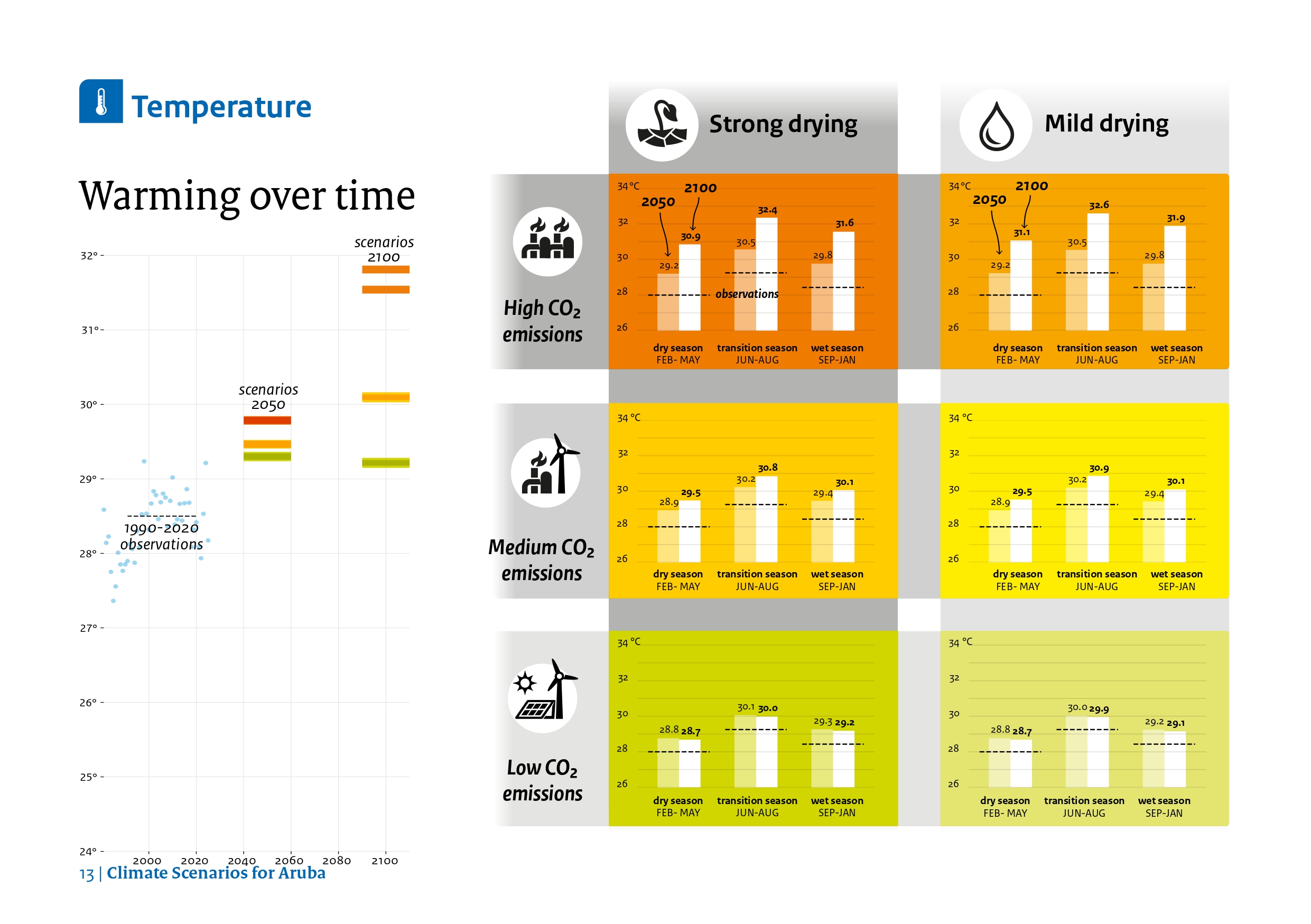
Aruba’s average temperature has already increased by 0.2°C per decade since 1985. According to climate scenarios for Aruba:
- By 2050, temperatures may rise 0.8–1.3°C
- By 2100, warming could reach up to 3.3°C
As a result, heat seasons will last longer. Hot days will become common. Health risks will rise, especially for seniors and outdoor workers.
According to the World Health Organization (WHO), prolonged heat exposure increases dehydration and cardiovascular stress.


More Hot Days Will Redefine Daily Life
Extreme Heat Becomes the New Normal
In the current climate, Aruba experiences 17 hot days per year. However, climate scenarios for Aruba show alarming changes:
- By 2050: Up to 150 hot days annually
- By 2100: As many as 292 hot days, nearly the entire year
This dramatic increase will push energy demand higher. Air conditioning use will surge. At the same time, public health systems must adapt quickly.
A related ArubaOnline.news article on sustainable energy and climate resilience in Aruba explains how solar and wind projects can offset rising energy demands.
Aruba Is Getting Drier
Rainfall Decline and Longer Dry Seasons
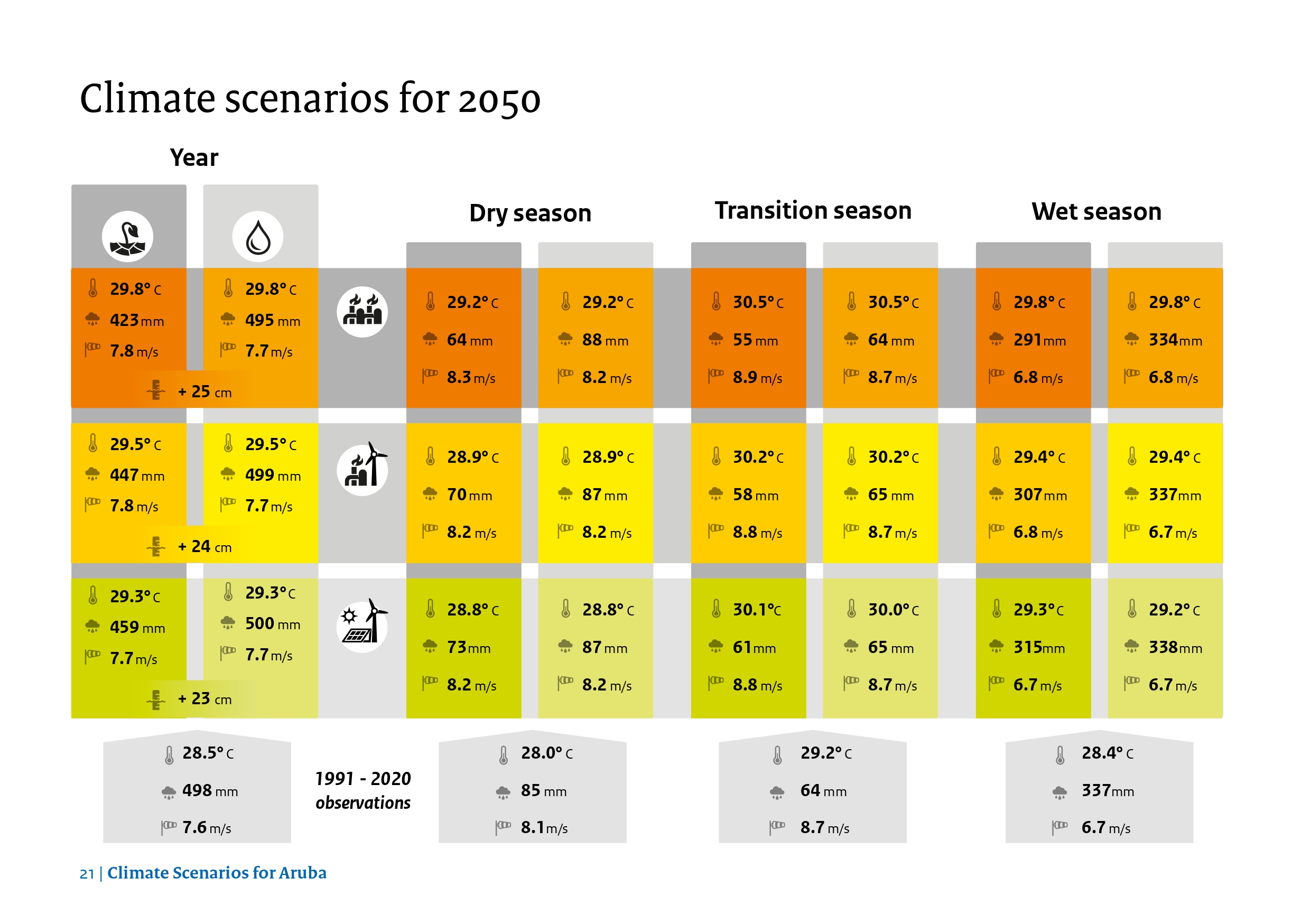
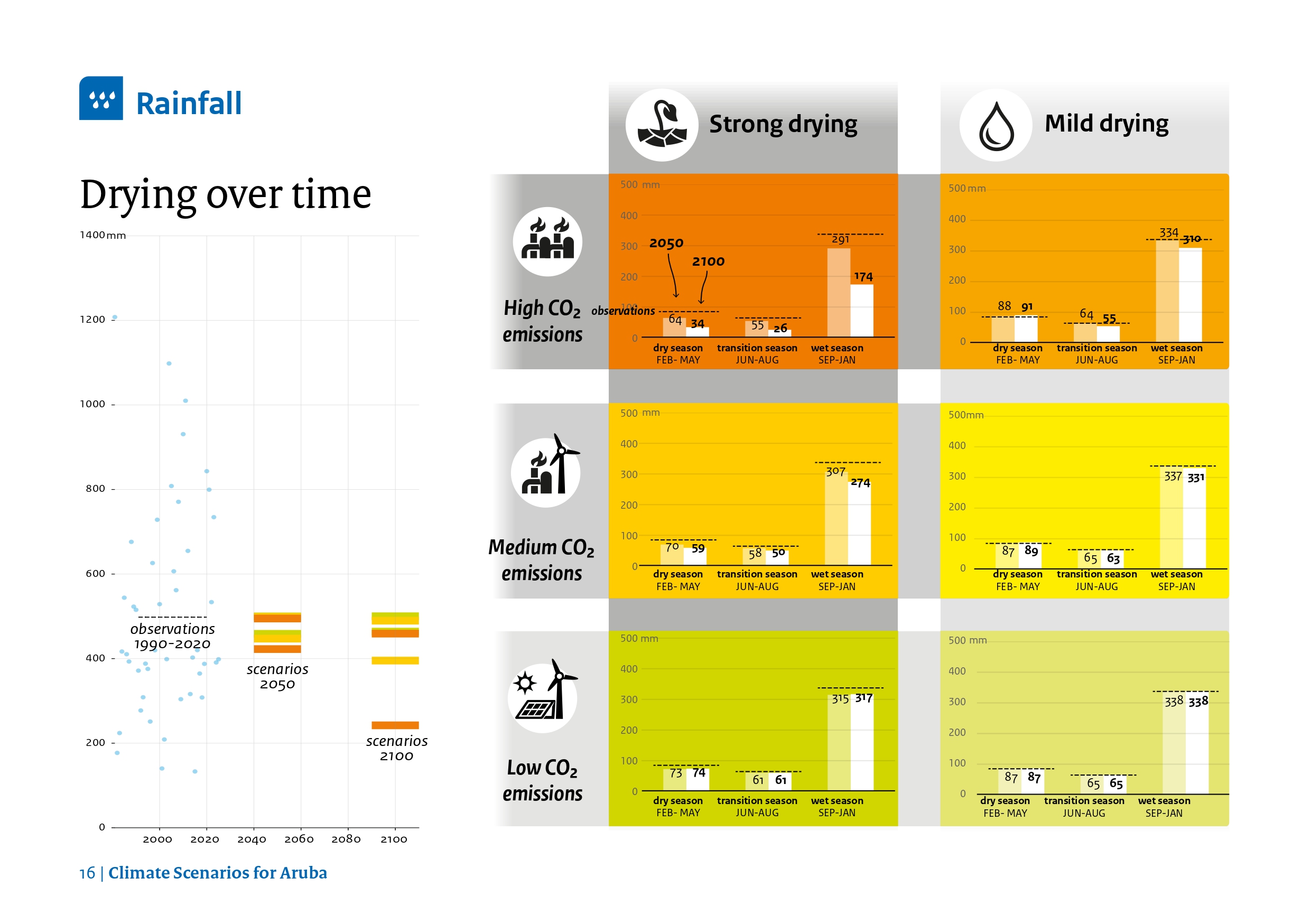
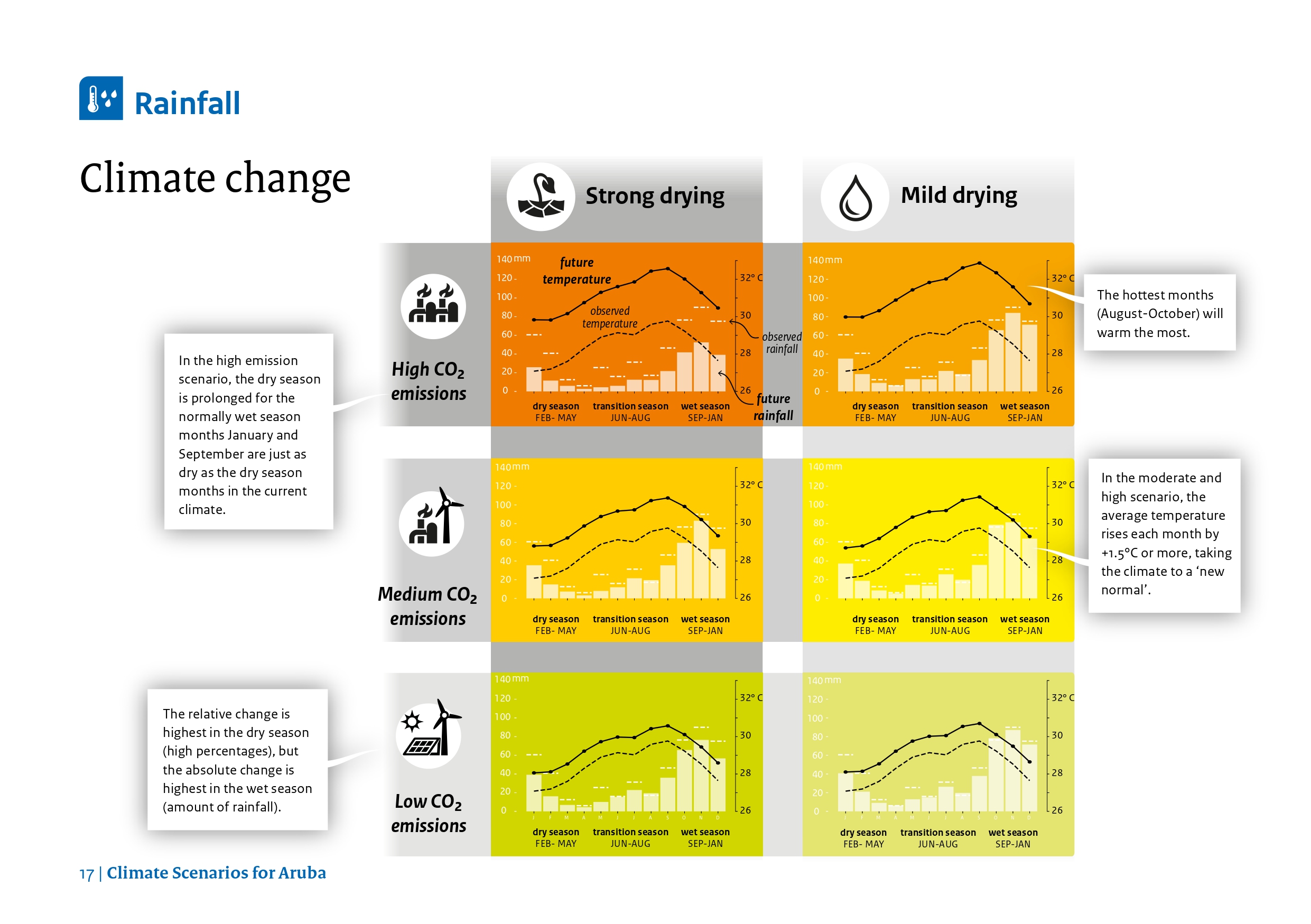
Rainfall is vital for Aruba’s ecosystems and water supply. Currently, the island averages 498 mm of rain per year. Climate scenarios for Aruba show:
- Rainfall could drop by up to 50% by 2100
- Dry seasons may extend into traditionally wet months
- Extreme dry years will become more frequent
El Niño events already bring severe droughts. Future warming could intensify these impacts, placing pressure on desalination, agriculture, and biodiversity.
The National Oceanic and Atmospheric Administration (NOAA) confirms that warmer climates intensify drought risks globally.
Climate Scenarios for Aruba and Water Security
Protecting a Critical Resource
Water security is one of Aruba’s greatest challenges. As rainfall declines, dependence on desalination will increase. Meanwhile, higher temperatures raise daily water demand.
The climate scenarios for Aruba emphasize the need for:


- Efficient water reuse systems
- Rainwater harvesting initiatives
- Smart infrastructure investments
Without action, water stress could threaten both residents and tourism.
Rising Sea Levels Threaten Aruba’s Coast
Sea Level Rise by 2050 and 2100
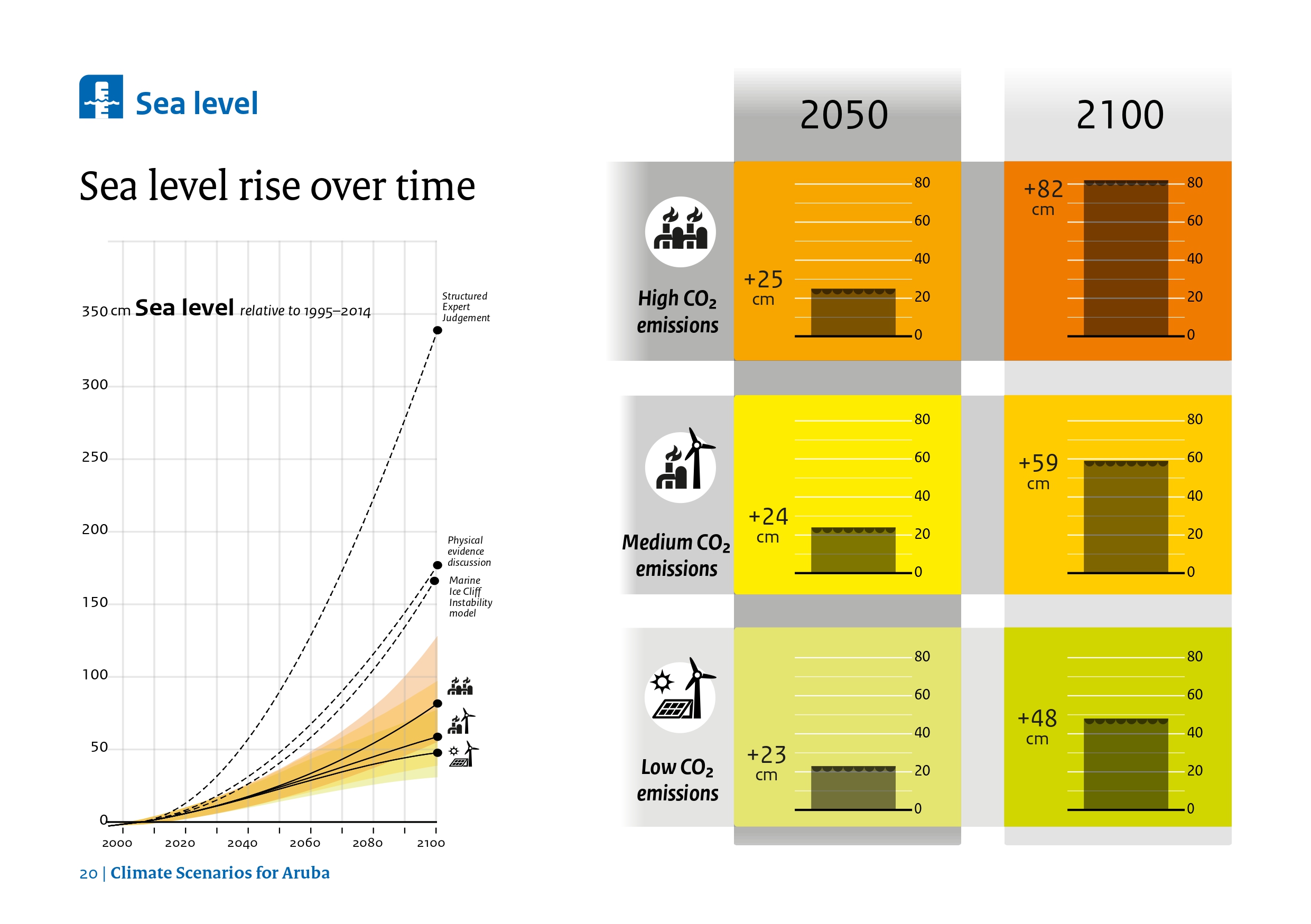
Sea level rise is among the most serious climate risks for Aruba. Observations show the sea is rising 3.9 cm per decade near the island.
According to climate scenarios for Aruba:
- By 2050: Sea level may rise 24 cm
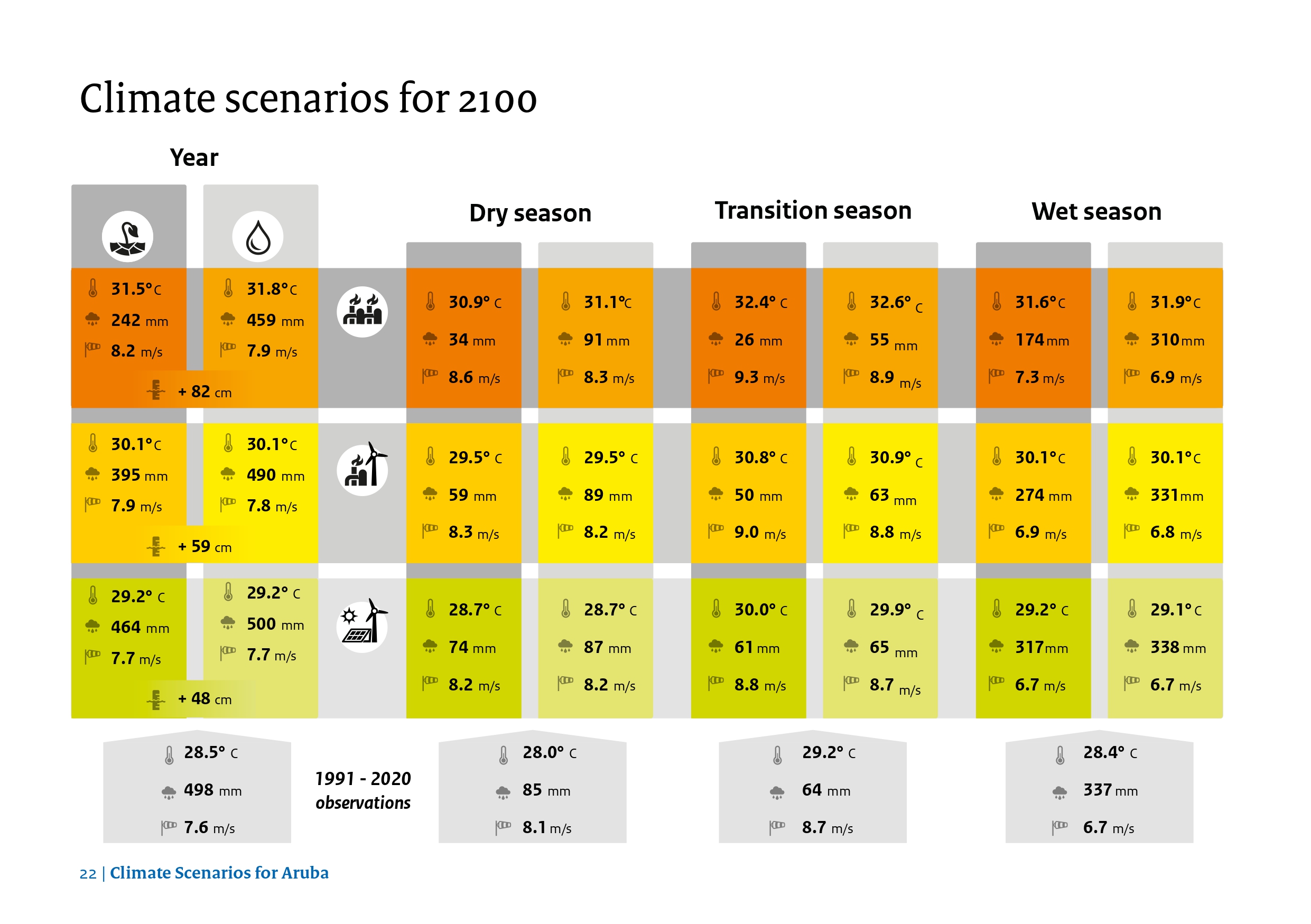
- By 2100: Rise could reach 48–82 cm
- Over future centuries, a 1-meter rise is inevitable
As a result, beaches will shrink. Flooding risks will increase. Coastal hotels and homes will face greater exposure.
The United Nations Environment Programme (UNEP) highlights that coastal adaptation is critical for island economies.
Economic Impact on Tourism and Infrastructure
Tourism is Aruba’s economic backbone. Climate change threatens beaches, coral reefs, and visitor comfort.
Coral Reefs Under Stress
Warmer seas cause coral bleaching. Bleached reefs offer less coastal protection and reduce marine biodiversity. This impacts diving, fishing, and shoreline stability.
Climate scenarios for Aruba stress the importance of marine conservation and reef restoration to protect tourism revenue.
Wind Speed Changes and Climate Balance
Unlike temperature and rainfall, wind speeds are expected to remain relatively stable. However, slight increases may occur during the wet season.
Stronger winds can help cool the sea surface through upwelling, reducing marine heat stress. This natural process may slightly offset warming impacts.

Climate Scenarios for Aruba in 2050
By mid-century, Aruba may experience:
- Average temperature near 29.8°C
- Reduced rainfall in dry seasons
- Sea level rise near 25 cm
- Increased frequency of extreme heat days
Adaptation actions taken now will strongly influence how severe these impacts become.
Climate Scenarios for Aruba in 2100
By 2100, projections show:
- Average temperatures exceeding 31°C
- Severe drying under high-emission scenarios
- Sea level rise up to 82 cm
- Coastal flooding risks intensifying
These long-term projections highlight why climate resilience must guide every national development plan.
Building Climate Resilience in Aruba
From Science to Action
Climate scenarios for Aruba are not warnings alone. They are tools for action.
Key resilience priorities include:
- Climate-resilient infrastructure
- Coastal protection projects
- Urban heat mitigation
- Renewable energy expansion
- Public health preparedness
A related ArubaOnline.news feature on Aruba’s National Climate Resilience Council initiatives explains how policy and science are aligning locally.
A Shared Responsibility for Aruba’s Future
Climate change is global. However, resilience is local.
While Aruba cannot control global emissions, it can control how it prepares. With science-based planning, smart investments, and community action, Aruba can remain safe, prosperous, and livable for future generations.
The climate scenarios for Aruba provide the clarity needed. The time to act is now.
For more local news, visit us and follow our social media pages. Share your news with us by sending it to info@arubaonline.news.